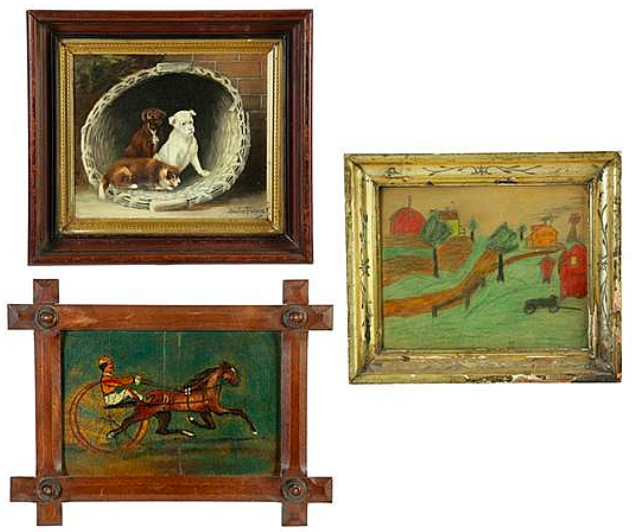
Credit: The Lewiston Daily Sun. [Maine] . By: Edith Labbie
Atherton Furlong, born of pioneer parents in Greenwood, was a man of many talents. He established the College of Vocal Art in Toronto, sang in Buckingham Palace, and originated a novel theory about teaching voice. His paintings are treasured by art collectors, and his poetry was widely published.
His is the story of a poor farm boy who used grit and determination to make the most of his many talents, pulling himself up to the ranks where geniuses of the time accepted him as an equal.
To begin with, Atherton had the best of ancestors. His grandfather, Thomas Furlong, was the second settler in Greenwood. He came to Norway in 1796 and moved to Greenwood six years later. Some say his was the first log house built beneath the brow of Furlong Mountain—what was the Joseph F. Lovering place near the end of the County Road in Norway. As late as 1955, lilacs and lilies still bloomed by the cellar hole.
“Uncle Tom,” as he was fondly called, once cleared an entire acrein a day by notching trees and knocking down the key one so that the others came down like kingpins.
Beyond the Patch Mountain Schoolhouse is “Uncle Tom” Mountain, which probably commemorates this pioneer. He and his wife are buried in the small cemetery on top of Patch Mountain.
His wife was as remarkable as he was. After providing plenty of home-grown labor in the form of six boys and two girls, she lived to be 110 years old. Her youngest children arrived when she was over fifty years old.
The oldest son, Isaac Patch Furlong, married Ruth Atherton and they had five children. Atherton was their oldest son, described as a “sweet-voiced lark” by the noted Norway writer C. A. Stephens. After the boy completed the courses at the Patch Mt. School he went on to Norway Academy. He was sixteen years old when he was graduated and left home to earn money for a higher education.
He was determined to train his voice, which friends and neighbors all said was the sweetest they’d ever heard. Having earned a nest egg, he went to the great Madame Ruderstorff, then teaching voice culture in this country (nothing but the best for Atherton Furlong). But when he learned how expensive the lessons would be, he resolved to teach himself.
On hearing of his intent, Madame put her nose in the air and replied, “Then you are a little fool!”
This rebuff made Atherton more determined than ever to become a celebrity. Some of his young friends were medical students, so he studied cadavers to find the secret of muscle control and its influence on the larynx, tongue, lips, etc. Then he designed his own exercises to strengthen his anatomy. It was difficult and lonely work, for he wasn’t at all certain he was on the right track.
His first reward—recognition by the famed Apollo Club—was followed by the directorship of the Park Street Church choir in Boston at the age of 22. Two young ladies from his home state (Annie Louise Cary of Durham and Lillian Norton Nordica of Farmington) were alsoin the choir, but their musical destinies lay far ahead of them.
From this time on, Furlong rapidly climbed the ladder of success. He studied in England with the leading instructors of his day. Before long he appeared in a concert with England’s greatest tenor, Sir Edward Lloyd. The young man gained still more incentive in 1873 when he was married to Carlotta Willington of Cambridge, Massachusetts, a young woman who also possessed a beautiful voice. The two gave many concerts together at fashionable English watering places.
Furlong sang in St. James Hall, London, and with leading oratorio societies of England, Paris, and Berlin. At Buckingham Palace in 1897, he sang in a state concert with the then-famous Adeline Patti. The couple gave a concert at the Royal Assembly Rooms at Margate where she sang Atherton’s original song, “Sweet Sixteen.” The lyric tells of a matron recalling that when she was ten years old, a little sweetheart said he would marry her when she turned sweet sixteen, if she “didn’t grow fat, thin, or ugly.” Now a single lady of 49, she says that if she had her days to live over, she’d marry at ten for she has no faith in “sweet sixteen.”
The Furlongs also gave concerts in Buxton Gardens and in the chapel at Islington, where they starred in Mendelssohn’s “Elijah.” The man from Greenwood won honors from the Sacred Harmonic Society in London, the oldest musical society in the world. Leading singers of his day became his intimate friends.
The Furlongs had four sons. The youngest, Lewis, also had a sweet voice and appeared in many concerts with his parents. He died at an early age but the other boys grew up to be fine men. The eldest—Col. Charles Wellington Furlong— became an explorer, author, and painter. Captain Leonard Furlong served 12 years in the Phillipines and was four times given the medal of valor. Atherton Furlong, Jr. inherited his parents’ musical talent and sang professionally as a baritone in light operettas. In later years he entered the piano manufacturing business.
Furlong found such joy in singing that he decided to share his pleasure, so he began giving lessons to a group of English girls. His method was so popular he soon had numerous classes. His_ special theory about singing derived from his early studies with his medical friends. He promised students that he could “overcome intonation roughness and tremulous bleating.”
“Think of yourself as a violin,” he said. “Your chest is the belly of the violin, the upper section of your vertebrae and trachea are the neck of the instrument. Your pharynx, hard and soft palate, jaws, teeth, and frontal bones are the sounding board. The S-shaped opening of the sounding board is your lips. Your vocal chords are the strings and your breath is the bow.
“Use, don’t abuse your violin,” he wrote. “Grown-ups seldom breathe properly but babies and children breathe deeply and well all day long so their voices have good resonance.”
He was 65 years old when he and his wife opened the College of Vocal Art in Toronto, in a prestigious location near the present University of Music.
One of his innovations there was a large tonal room, a predecessor of modern accoustical designing. Reviews of the school’s recitals appeared in Toronto papers in 1914 and 1915. Seventy pupils performed and the reporter called it “a tremendously long program.” Furlong earnestly believed that everyone should be given an opportunity to demonstrate the result of his past year’s work.
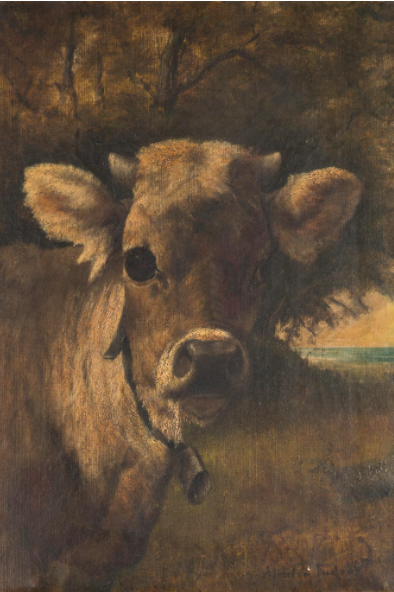
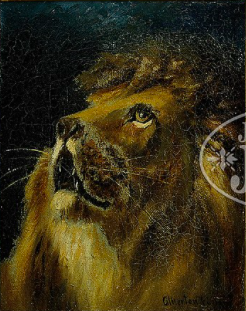
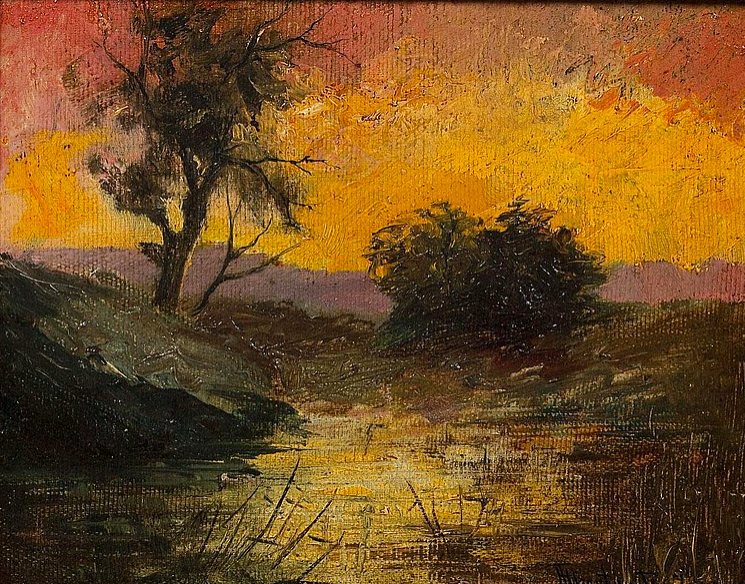
His urge for self-expression also took another form. Thinking back to the beauty of the Oxford Hills, he became so nostalgic that he began to transfer his memories to canvas. In painting, he revived his formula for success: practice and experimentation. His specialties were landscapes and animal life. The most famous painting—”Jerry,” the head of an Angus bull—sold for $15,000 (a great fortune in those days) in New York in 1887.
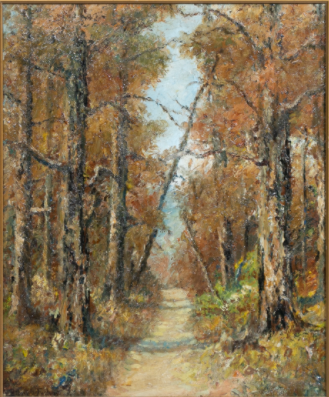
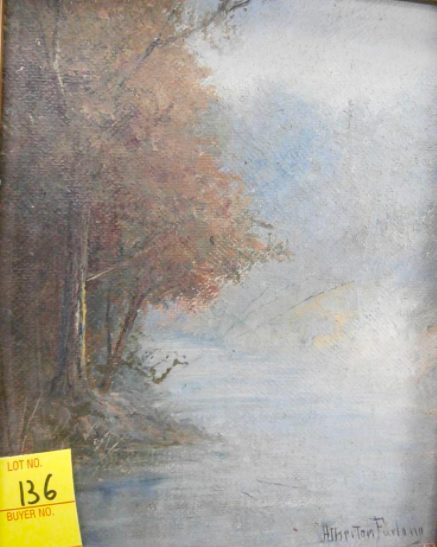
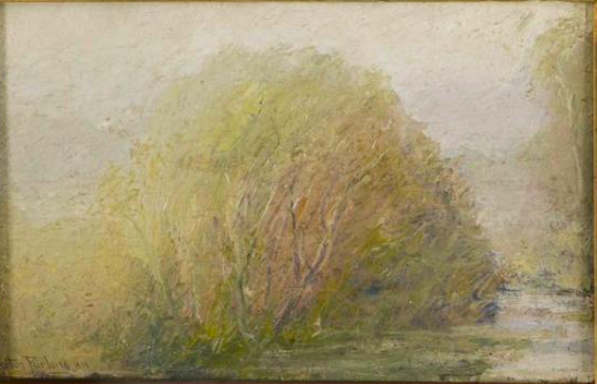
Many titles of his paintings reflect his love for the land of his childhood. “The Last Load,” “Among The Hemlocks,” “Blue Mountains,” “Spring Stream,” “Wind Swept,” are among those still treasured by collectors. A tireless worker, Furlong was working on one of his finest paintings only two days before he died.
Creativeness surged through Atherton Furlong and it also surfaced in the form of poetry. There were innumerable unpublished poems found among his possessions after his death on October 13, 1919. His lyric poem, “Mystery,” has been included in many American anthologies.
Remarkably enough, Furlong retained his singing voice to the end of his days. He was still listed as a vocalist the very year of his death.
He now sleeps beneath a natural stone boulder in the Pine Grove Cemetery in South Paris. His good friend, the noted Norway artist Vivian Akers, searched the woods for just the right stone on which is engraved: “Atherton B. Furlong, 1849-1919, Artist, Singer, Poet.”
The stone was dedicated in 1953 in a special ceremony arranged by Atherton’s son Charles. Rev. Bertram Wentworth, who now resides in Mechanic Falls, read an appropriate Bible verse and Furlong’s poem, “Mystery.” Col. Furlong delivered the eulogy.
The old Furlong homestead has been crushed by the snows of winter, but Furlong Pond and the memory of the determination of Atherton Furlong still memorialize the family name.
~Mrs. Labbie is a reporter for The Lewiston Daily Sun.
Bio / Obituary: Credit Find a Grave:
In the death of Atherton Furlong at his studios, 382 Yonge Street, yesterday
morning, Canada and the United States loses one of the noted singers
and artists of the day. He was also recognized as one of the greatest masters in
Europe, where he was sent as representative oratorio and ballad tenor of the United States in 1880. He sang in St. James’ Hall and led oratorio societies in the capital cities of European countries.
Since coming to Toronto from abroad seven years ago, there was not a year
but what he brought out some new singers. Among his works of art, probably
the painting “Jerry”, which was sold for $15,000 from the Schaus’ Galleries,
Fifth Avenue, New York, about 1887, was his masterpiece.
This was a picture of a pedigree bull belonging to the herd of the Duke of Northumberland.
Many of his fine paintings are on the walls of his studio on Yonge Street.
These alone are valued at between $60,000 and $70,000.
Mr. Furlong was also an author. At the time of his death, his latest novel, “People of the Blue Ridges, By One of Them.”, was ready for the publishers. This dealt with the author’s
early life in his native State of Maine. “Echoes of Memory”, volume II. was also completed.
Volume I was published in the ’80s.
One of his poems, “Mystery,” the author recited at the Lambs Club in New York.
Mr. Furlong also contributed to several newspapers. His coterie of friends on both continents included many famous men in the world of literature, art, and music, and his clientele as a tutor was select and extensive.
He was a great friend of Patti’s.
He was born in Greenwood. Oxford County, Maine, U.S.A., in the early fifties.
He is survived by his two sons, Major Charles Wellingotn Furlong of the
United States Army and Atherton Bernard Furlong of Cincinnati.
Mr. Furlong had been ill from pleurisy, from which he never fully recovered
An attack of heart failure was the immediate cause of death.
Obituary: Atherton Bernard Furlong: Artist, Singer, Poet

Atherton Furlong (1849-1919)
Photo courtesy of the Greenwood Historical Society
~Editor’s Note: The following obituary of Atherton Furlong appeared in the 24 October 1919 issue of the Norway Advertiser and was provided by Society member Larry Glatz of Harrison, Maine. Much gratitude is also extended to Blaine Mills of the Greenwood Historical Society for furnishing the photograph of Furlong, who was born in the Patch or Furlong Mountain section of that town. Furlong married three times, but his sons were by his first wife, Carletta E. Wellington. The second wife’s name is not recorded. His third wife was Kaloola Lovett of Portland, a noted singer.
The funeral services of Atherton Bernard Furlong were held Sunday afternoon at the Universalist Church, Rev. C. G. Miller, officiating. The bearers were Charles S. Akers, Frank Kimball, Frank H. Noyes and Herman L. Horne, all of Norway. Interment was in Pine Grove Cemetery, according to his last wish.
In the death of Mr. Furlong, which occurred at his studio, Toronto, Canada, a noted artist, distinguished for his remarkable versatility in singing, painting, and writing has gone. He was born in Greenwood, seventy years ago. Here he obtained his early education in the district schools of Greenwood and the academy at Norway. At the age of sixteen, he started out for himself and first in Buffalo, then later in Boston, worked hard to obtain a musical education. Boston knew him in the early days of his career, when as a youth of twenty-two, he became a member of the Apollo Club and also assumed the musical directorship of Park Street Church during the pastorate of the Rev. W. H. H. Murray. There among those under his instruction were Lillian Norton (Nordica), and Anna Louise Carey, one of America’s most noted church singers. Shortly after arriving in Boston, he took stock of his possibilities and sought an audience with Mme. Rudersdorff, Richard Mansfield’s mother. Upon hearing her fees for lessons, he declared he would teach himself, and although Mme. Rudersdorff told him he was a “fool,” he persevered in his determination.
Some of his young friends in Boston were medical students, with whom he attended clinics. Through his study of anatomy, he worked out the physical principles of voice production—just as later he found out for himself the colors of his first painting. Later Mr. Furlong was solist in a Chicago choir with Dudley Buck as organist, subsequently singing under the same director at Holy Trinity in Brooklyn. About this time, there was an opportunity for an oratorical tenor to obtain an opening in that field in England. The aspirants were required to sing before a committee, one member of which was Mme. Rudersdorff. Mr. Furlong won the competition and took occasion to remind Mme. Rudersdorff (who had not recognized him) that he was the same self-taught lad whom she had pronounced a “fool.” Thus Mr. Furlong was selected out of fifty-four tenors to succeed at that time the late Joseph Maas. In England he studied with Alberto Bandegger. His career in England was marked with all possible honors, notably at the Sacred Harmonic Society of London, the oldest musical society in the world and many times at the Royal Albert Hall. Among his close friends with whom he sang with were Simmes Reeves, Santley, Mme. Albani and Adelina Patti, singing with Patti at the Royal State Concert at Buckingham Palace.
As a painter, Mr. Furlong was known in both America and England as an artist of landscape and animal life. His work ranks with the leading painters of the past centuries. Of his many works, perhaps the painting of “Jerry” which sold for $15,000 from the Chaus Galleries in New York about 1887, is the masterpiece of his animal subjects. This is a life size painting of a bull belonging to the herd of the Duke of Northumberland. “Among the Hemlocks,” owned by W. E. E. Stokes; “Greeting the Morn,” owned by Charles F. Yerkes, Chicago; and the “Midnight Watch,” owned by Hanna J. Noyes, are among many of his noted paintings in this country.
His work is distinguished by great individuality, of refinement and delicacy. Always an indefatigable worker, time found him creating some of his strongest works the past summer, standing at his easel only two days before his death softly took brush and pen from the hand of the great master, and stilled the sweet music of which he had given so freely; for its seemed his great joy in life was to give his talents and to encourage youth in the realization of ambition.
After teaching in London and Berlin, he returned to America and for the past seven years has conducted the College of Vocal Arts in Toronto, as founder and director. His recitals have been one of the features of the musical season.
Poetry of words seemed as essential a means of expression to Mr. Furlong as poetry of sound and vision. His published works have placed him among the recognized American poets and are best represented in the second edition of his volume, Echoes of Memory. His poem, “Mystery,” has already found its place as one of the greatest poems of American literature.
Mr. Furlong is survived by two sons, Major Charles Wellington Furlong, who was one of the President’s party on his overseas trip, and Atherton Bernard Furlong, Jr., of Cincinnati. Services were held in Toronto, where a large concourse of friends and students paid their last tribute to their beloved master. During the summer of 1918, Mr. Furlong spent his vacation in Norway.
From Groves Dictionary of Music and Musicians:
Furlong, Atherton Bernard (b. Greenwood,
Me., 1849), after study in Boston and abroad,
from 1870 was concert-tenor in Boston, from
1872 in Brooklyn, from 1880 in England,
France and Germany with oratorio societies,
and since 1888 has been head of the College of
Vocal Art, Toronto. He has composed songs,
published a novel and poems, and exhibited
animal and landscape paintings.
As mentioned above Mr. Furlong was heavily involved with the arts, both visual and musical. Below are some known works that Atherton created:
Booklet:
Beauty in Nature
Books:
Echos of Memory, English, [1884]Publisher: Field & Tuer, London, [1884]
[CLICK for BOOK}
American Landscapes and Animal Studies, English, [1911] Publication: Modern Gallery.
Musical Score:
A Night Song, English, 1887 Publisher: C.H. Ditson & Co., New York, 1887
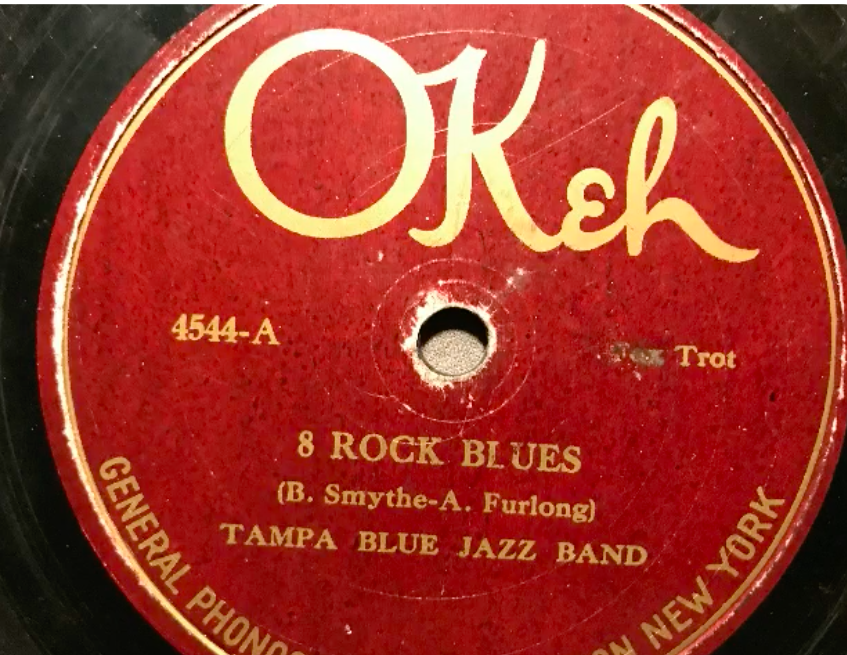
8 Rock Blues, English, ©1921Publisher: Billy Smythe Publisher, New York,
{CLICK for Recording]
Musical Lyricist:
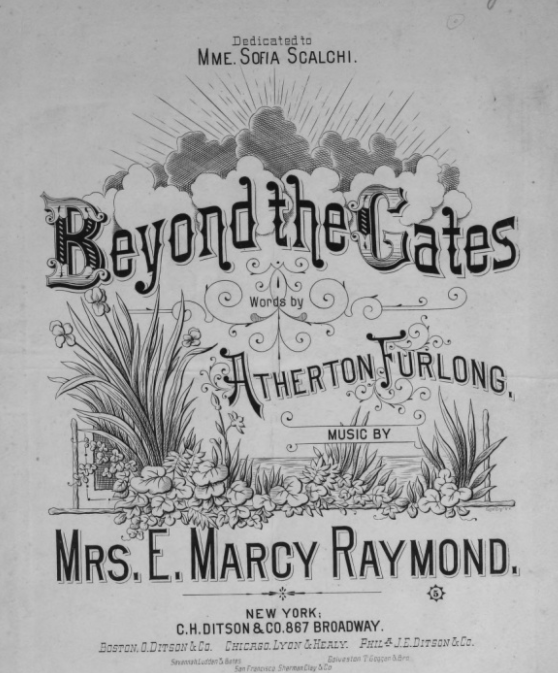
Beyond the Gates Musical Score, English, 1887Publisher: C.H. Ditson & Co., New York,
1887
A Night-Song=Nachtlied ;(contralto or baritone). Edition: AltPublisher: Edward
Schuberth & Co., New York, N.Y., ©1893
Composer:
8 Rock Blues, No Linguistic Content, 1922Publisher: OKeh, New York, 1922
Beyond the Gates Cover.
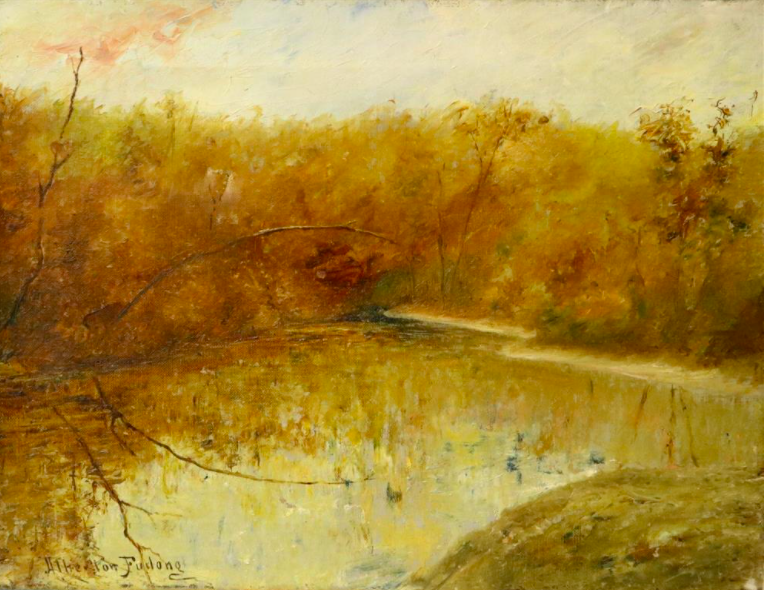
Known Paintings by Mr. Atherton Furlong:
Early October. Oil on Canvas
” Jerry”, Young Tom. Oil on Canvas
Forrest Landscape. Oil on Canvas
Trees Aong a River Bend. Oil on Canvas
Trees Along a Riverbank. Oil on Canvas
Lion. Oil on Canvas
Riverbank at Sunset. Oil on Canvas
Canine. Oil on Canvas
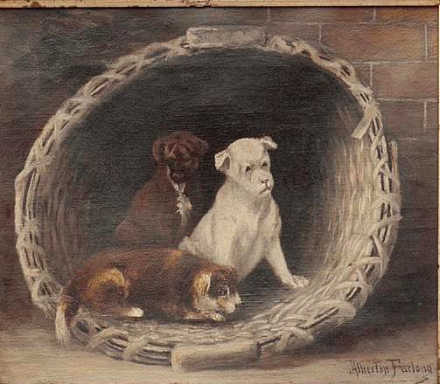
Puppie, Oil on Canvas. – Race Horse, Oil on Panel. – Farm Scene, Crayon.